

Lawn care pricing by square footage
Work through an 8,200-square-foot mowing visit, then replace the time, costs, and minimum with your own.
Count the complete visit
Start with the mowing area on the satellite map. Use square footage to estimate time—not price by itself. Two lawns of the same size can take different amounts of work because of access, trimming, growth, and the equipment you can use.
Our hypothetical job has 8,200 sq ft across a front, side, and fenced back lawn that is mowed weekly. One person uses equipment that fits the gate and leaves clippings on the lawn. The complete visit takes an estimated 45 minutes, including its share of travel.
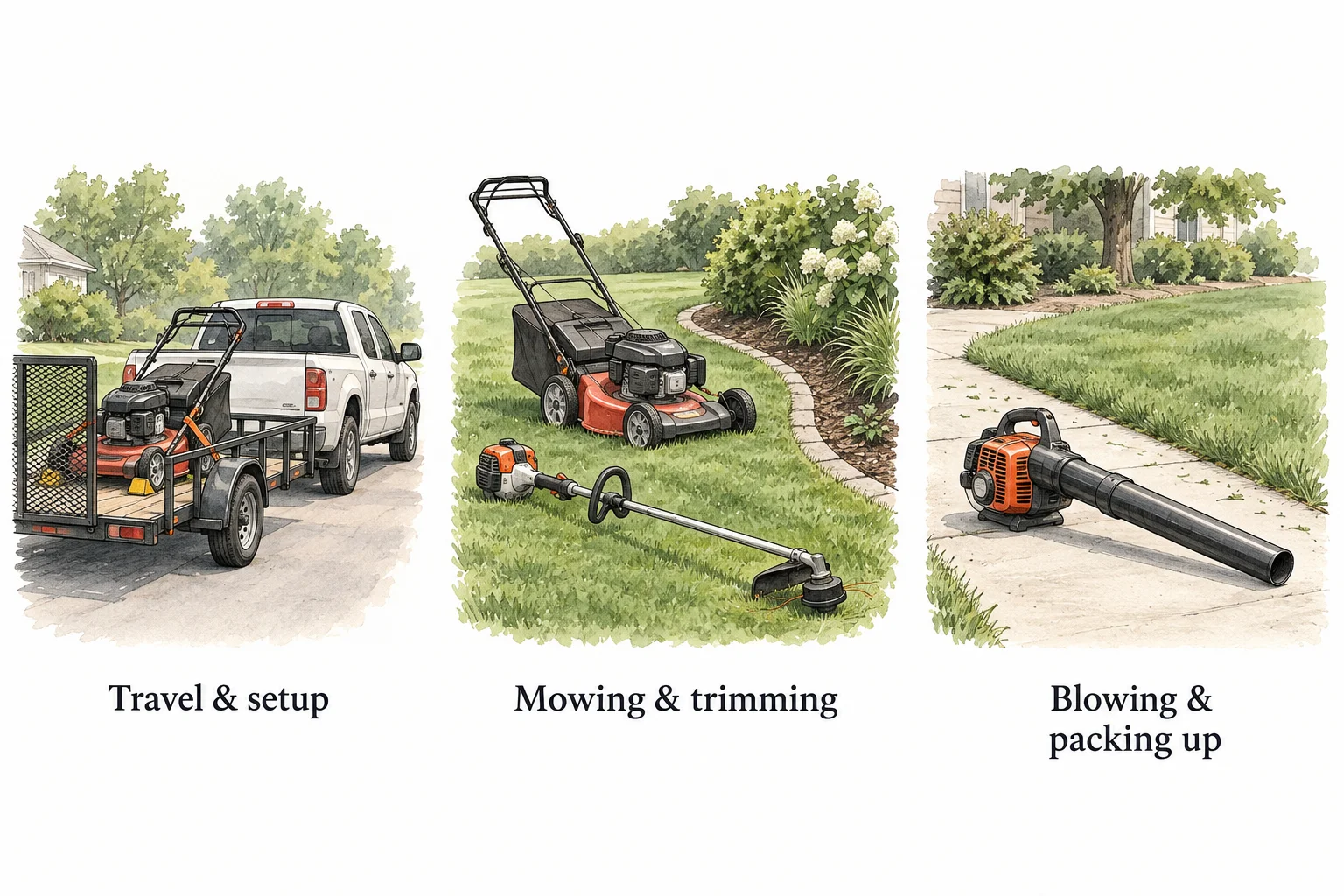
- Travel and setup — 10 minutes
- This stop’s share of route travel, parking, unloading, and getting started.
- Mowing and trimming — 32 minutes
- 25 minutes mowing, plus 7 minutes trimming and edging around the fence, two tree beds, walk, and driveway.
- Blowing and packing up — 3 minutes
- Clear clippings from pavement and put the equipment away. No bagging or haul-off is included.
Use times from similar jobs and your actual equipment. Count person-hours: one person for 45 minutes is 0.75; two people each working 30 minutes is 1.0, not 0.5.
Set a business rate, not an employee wage
Your fully loaded hourly target must cover payroll—including your own work—routine fuel and equipment, insurance, administration, and profit. Divide costs across realistic working hours, not every hour on the calendar. Rain days, maintenance, and gaps in the schedule still have to be paid for.
For this example, assume those costs total $60 per productive person-hour. An $80 hourly target leaves $20, or 25% of revenue, above those costs. That is a hypothetical business model, not a national lawn-care rate or an $80 employee wage.
Add a job-specific expense only when it is outside that target. Routine fuel should not appear twice. Disposal, a special rental, or unusual hauling may be separate; this normal mowing visit has $0 of direct extras.
See the price come together
Same 8,200 sq ft weekly job, one worker, normal growth. All dollar values are example assumptions, before any applicable tax.
| Estimate step | Example value | How to use it |
|---|---|---|
| Total person-hours | 0.75 | 10 + 32 + 3 = 45 minutes for one worker; divide by 60. |
| Fully loaded hourly target | $80 | Covers payroll, routine operating costs, overhead, and the example profit target. |
| Direct extras | $0 | Routine mowing with clippings left on the lawn; no separate disposal charge. |
| Calculated price | $60 | 0.75 person-hours × $80 + $0. |
| Minimum visit | $50 | The business’s example floor for routine service, not an extra charge. |
| Quoted flat price | $60 per visit | Use the higher of $60 calculated or $50 minimum. |
That works out to about $7.32 per 1,000 sq ft. Use that as a comparison with similar maintained lawns, not a rate to multiply across every property. The minimum, route travel, and trimming do not shrink in proportion to lawn size.
What changes the price?
- A tiny stop: 20 person-minutes at $80 per hour comes to $26.67. With no extras, the $50 minimum becomes the quote. Apply the minimum once; do not add it on top.
- Slower access or more trimming: another 15 minutes changes the example from 45 to 60 minutes, so the same hourly target produces an $80 visit—even though the square footage is unchanged.
- An overgrown first cut: quote the extra labor, disposal, or hauling separately from routine weekly mowing. Include only costs not already covered by the hourly target.
State what the minimum covers. Extra materials or disposal may need to sit outside that floor; make the treatment clear in the estimate rather than counting them twice.
Check the estimate against the first visits
Record travel/setup, mowing/trimming, and blowing/packing time separately. If the $60 example actually takes an hour, it earns $60 per person-hour before expenses—not the planned $80. Find the cause: route distance, equipment access, growth, or missing work in the original estimate.
Use the recorded time for the next similar property and discuss any service or price change with the customer before applying it. Revisit the hourly target and minimum when payroll, insurance, equipment, or route costs change.