
Choose grass seed that fits your lawn
Compare grass types, make sense of a soil test, and turn the seed label into a practical shopping list.
Choose the grass before the bag size
If you’re filling thin spots, start by identifying the grass you already have. Adding a different type can change the lawn’s texture, color, and growing season. A seed mixture can be intentional; a random bag from the sale shelf is a different matter.
For a new lawn, use your growing region to narrow the choices, then consider sunlight, foot traffic, and how much watering you want to do. A grass that handles winter well may still struggle through your summer.
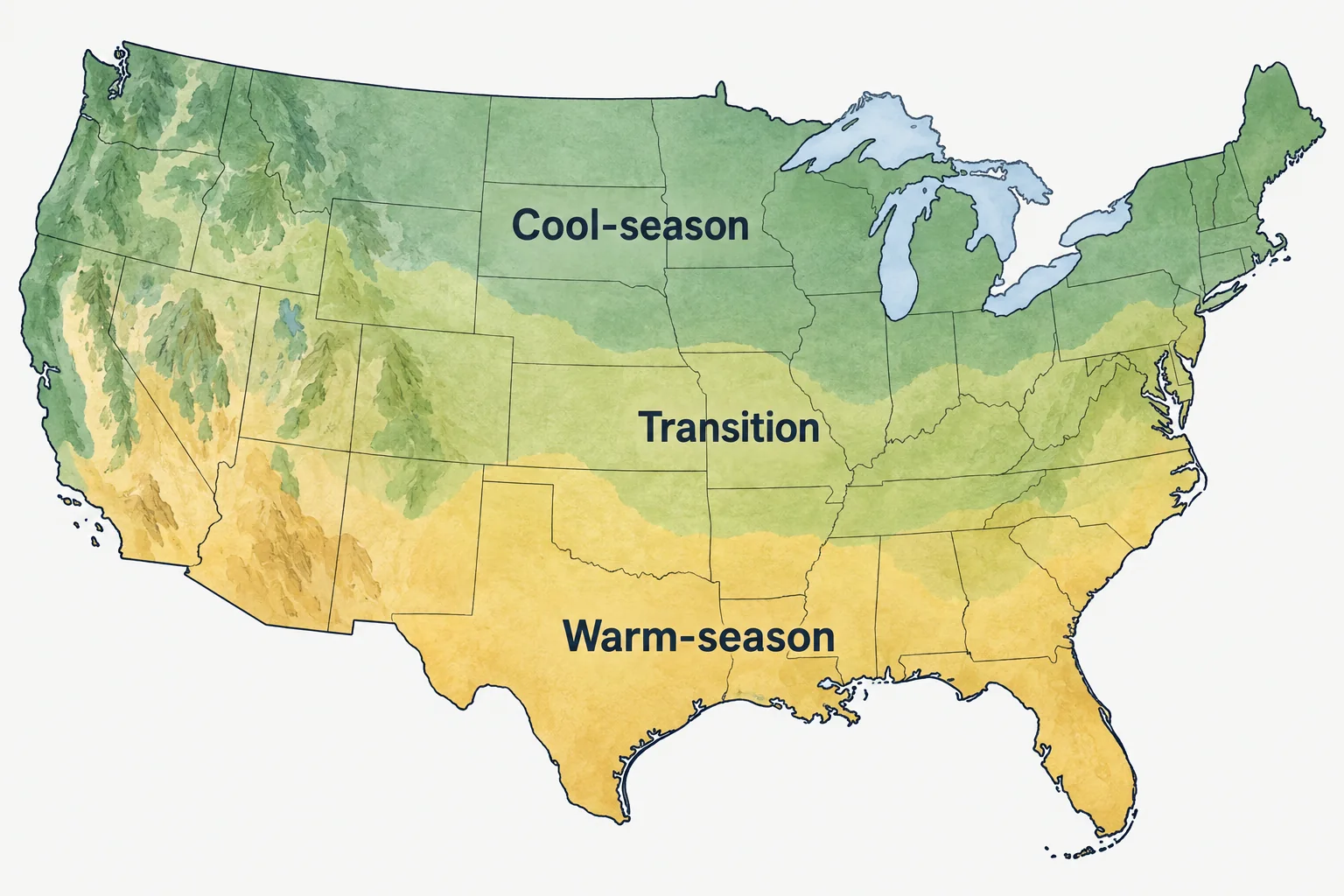
- Cool-season regions: much of the northern US and cooler climates. Compare Kentucky bluegrass, turf-type tall fescue, fine fescues, and perennial ryegrass. These grasses do most of their growing in cooler weather.
- Transition region: the middle ground with hot summers and cold winters. Tall fescue and locally adapted warm-season grasses are common options, but neither group avoids every seasonal tradeoff.
- Warm-season regions: much of the southern US. Bermuda, zoysia, St. Augustine, centipede, and bahia suit different sites—not all are sold as seed. Expect many warm-season lawns to turn brown during winter dormancy.
The western US is especially varied: cool coasts, high elevations, and hot desert valleys do not share one lawn recipe. Alaska and Hawaii are outside this illustration; use locally adapted varieties and regional planting guidance there.
USDA hardiness zones describe winter minimum temperatures, not a complete grass-selection rule. The illustration uses broad turf-growing regions instead.
Match the seed to the yard you actually have
Look at the lawn at different times of day. Morning sun and afternoon shade are different from shade all day. “Shade tolerant” does not mean grass will thrive without enough light.
| Grass | Worth considering for | Before buying |
|---|---|---|
| Turf-type tall fescue | Cool-season and transition lawns; sun to moderate shade. | Generally handles heat better than other cool-season choices. Bare spots usually need reseeding. |
| Kentucky bluegrass | Cool climates where a spreading lawn can repair worn patches. | Slower to establish than ryegrass; summer heat and water availability matter. |
| Fine fescues | Cooler, partly shaded lawns with lighter use. | Not the strongest choice for heavy traffic or hot, humid sites. |
| Perennial ryegrass | Quick establishment in suitable cool climates, often in mixtures. | Annual ryegrass is different; don’t mistake temporary cover for a permanent lawn. |
| Bermudagrass | Warm, sunny lawns with regular foot traffic. | Poor shade tolerance. Seeded varieties are not interchangeable with hybrid sod. |
| Zoysiagrass | Warm and some transition lawns; sun to light shade. | Slow establishment; only some varieties are available as seed. |
| St. Augustinegrass | Warm coastal climates where some shade tolerance is useful. | Buy sod or plugs, not a bag of seed. Cold and wear tolerance are limitations. |
Compare named varieties, too. Two bags labeled “tall fescue” can contain different cultivars. A blend combines varieties of one species; a mixture combines species. Read the ingredients rather than choosing solely by “sun and shade” on the front.
Regional advice narrows the list; it isn’t a nationwide guarantee for a variety.
Let a soil test decide the extras
Before buying lime or fertilizer for a new lawn—or trying to fix one that repeatedly struggles—get a lab soil test. It can tell you about acidity and nutrient levels. It won’t diagnose shade, compaction, or poor drainage; those problems need more than a different fertilizer.
Take a sample that represents the lawn
- Choose a lab first. Your state’s Cooperative Extension office can point you to a lab and submission form. Select the lawn/turf test and identify your grass and whether you’re establishing or maintaining it.
- Follow that lab’s depth and sample-count instructions. With a clean trowel, remove surface debris and take several small samples across the area. Don’t sample only the worst patch or a recent fertilizer spill.
- Mix comparable soil. Combine samples from areas with similar soil and treatment history in a clean container. Sample a distinctly different problem area separately. Similar lawn areas can share one test.
- Prepare and send as directed. The lab specifies drying, quantity, packaging, and the submission fee. Keep the report so you can compare future results.
Read the recommendation, not just the numbers
- pH and lime: use the lab’s recommendation for your grass. A low pH alone does not tell you how many pounds of lime to spread; some grasses prefer more acidic soil.
- Phosphorus and potassium: look for the lab’s low, sufficient, or high rating and recommended application. Don’t add a high-phosphorus starter automatically when the soil already has enough.
- Nitrogen: a routine report’s recommendation may be based on the grass and intended use, not a measurement of a lasting nitrogen supply. Check whether the rate is for one application or a full year.
For example, a report recommending no lime and no phosphorus is a reason to leave those products out of the cart—not buy a standard lawn-starting bundle anyway. Follow its remaining recommendations and the product label.
Fertilizer pounds are not nitrogen pounds
A 20-0-10 fertilizer is 20% nitrogen by weight. If your lawn guidance calls for 0.5 lb of nitrogen per 1,000 sq ft for one application, that means 2.5 lb of this product per 1,000 sq ft: 0.5 ÷ 0.20. On an 8,000 sq ft lawn, that is 20 lb of product.
This is a conversion example, not an application recommendation. Use the rate and timing for your grass, soil report, local nutrient rules, and chosen label. If the seed mix already contains fertilizer, account for it before adding another product.
Turn the label over
The useful comparison is on the seed label, not just the front of the bag.
- Grass species and varieties: these should match the lawn you want to establish or thicken.
- Purity and germination: purity is the share of the package that is that seed; germination is the share that sprouted in the test. A heavier package does not necessarily contain more viable seed.
- Test date, weed seed, and other crop seed: compare current label information and avoid introducing unwanted plants. “Other crop” is not automatically a useful lawn grass.
- Inert material and coatings: these add weight without adding grass seed. Patch mixes may also contain mulch and fertilizer. Compare their stated coverage for your job, not pounds against plain seed.
Use the overseeding rate for an existing lawn and the new-lawn rate for bare soil. Don’t assume the largest coverage number on the package applies to both.
Work out how many bags to buy
Measure the area you intend to seed, leaving out buildings, pavement, and beds. You can use one measurement or add several together. Separate calculations are useful when areas need different rates or products.
Here’s a hypothetical order: 8,000 sq ft × 5 lb per 1,000 sq ft = 40 lb. If you choose to allow 10% extra, the purchase estimate becomes 44 lb. Use your own seed label’s rate—not this example rate.
| Bag size | Bags to buy | Left over |
|---|---|---|
| 10 lb per bag | 5 bags | 6 lb left over |
| 25 lb per bag | 2 bags | 6 lb left over |
| 50 lb per bag | 1 bag | 6 lb left over |
All three choices give you 50 lb. Compare the total checkout cost, including delivery, and whether you can comfortably lift the bags. The smallest number of bags is not always the cheapest or easiest order.
Extra is a purchase allowance, not permission to spread more thickly. Apply the label rate and keep the remainder for suitable touch-ups. Don’t add another 10% when counting bags.
Have a planting window and a watering plan
For cool-season lawns, late summer into early fall is generally the stronger seeding window. Warm-season grasses are generally established in late spring or early summer. Adjust for your climate and grass rather than following one nationwide calendar date.
Make sure you can keep the seedbed moist through germination. Check sprinkler reach before planting, and arrange help if you’ll be away. Once seedlings establish, watering changes; follow the establishment instructions for your grass.
Seed needs contact with soil, not a cushion of dead grass. If you use straw or another cover, choose a clean material and a light layer that won’t bury seedlings. Check any weed-control product’s reseeding interval before treating the area.