

Choose a spreader for grass seed and fertilizer
Choose a hand-held, broadcast, or drop spreader—and a model that fits the lawn you actually have.
Choose the spreading pattern first
For an open lawn, a walk-behind broadcast spreader is a useful starting point. For tight strips beside beds and pavement, a drop spreader gives you a narrower, easier-to-place pattern. For a few patches, a small hand spreader—or one you can borrow—may be plenty.
Measure your lawn on the satellite map before comparing sizes. Lawn shape matters too: a wide-open 5,000 sq ft lawn is a different job from the same area split into narrow strips.
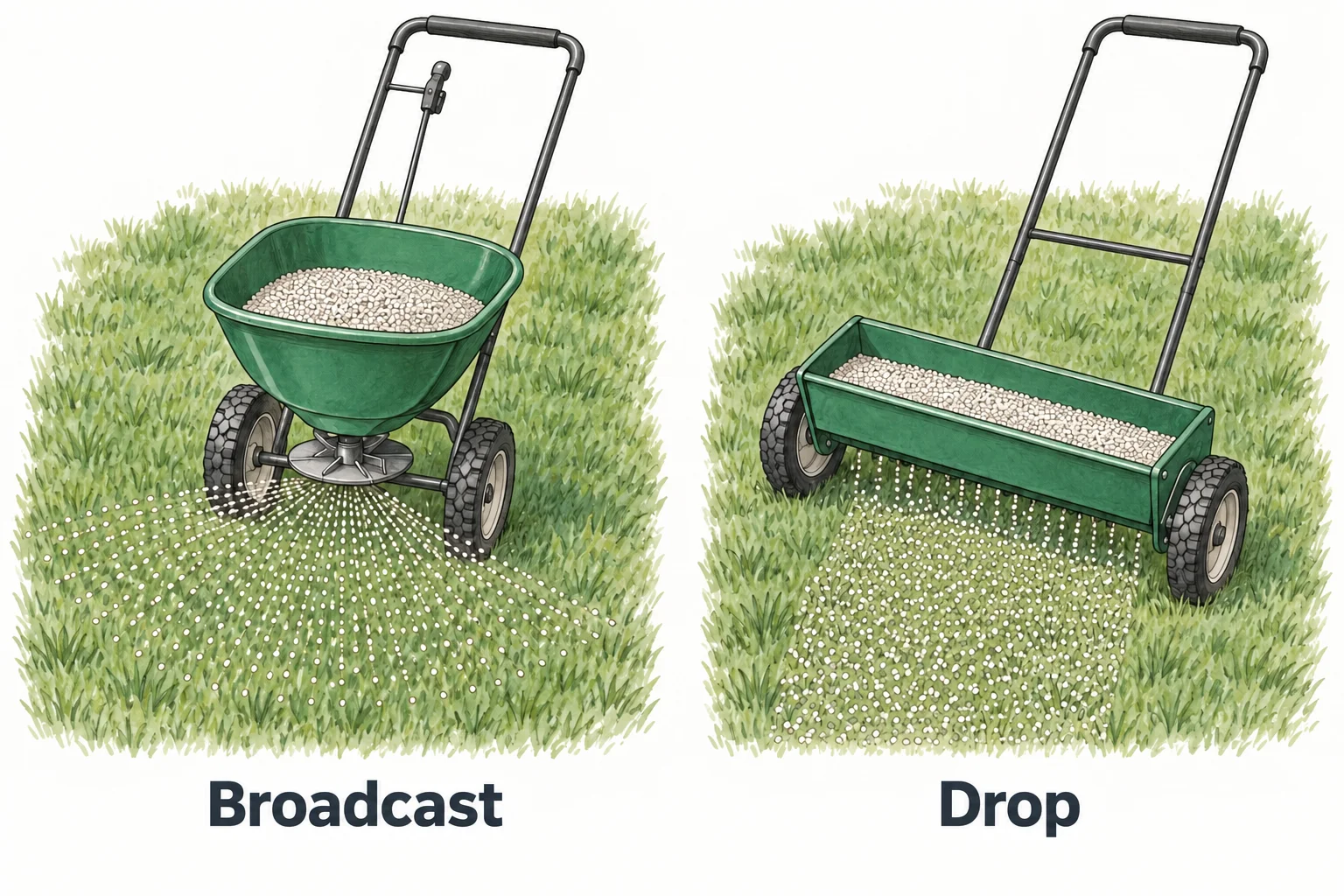
| Type | A good fit for | The trade-off |
|---|---|---|
| Hand-held broadcast | Small patches and occasional light loads. | You carry the product and keep your pace and cranking consistent. Frequent refills get old. |
| Walk-behind broadcast | Open lawns and repeated full-lawn applications. | The pattern extends beyond the wheels. Manage overlap and keep product out of beds and pavement. |
| Drop | Narrow lawn sections and defined borders. | More walking and a greater risk of stripes. Missed passes leave untreated lines; too much overlap can concentrate fertilizer and burn the grass. |
Compost, peat moss, and soil are a separate equipment decision. They do not belong in an ordinary granular seed spreader. See how to spread compost and which tools to use.
The spreaders we recommend
Keep the spreader you have if it works with your material, shuts off cleanly, and spreads evenly. If you need one, these are our picks by the job they suit, based on manufacturer specifications rather than hands-on testing.
- Small patches: Scotts Whirl. The hand crank and adjustable arm support suit light, occasional jobs. Choose it when you would rather carry a small hopper than store a push spreader. Check that your product lists a compatible hand-crank setting; it is not suitable for every seed or weed-and-feed product.
- Whole-lawn seeding and feeding: Scotts EdgeGuard DLX. This is our starting choice for an ordinary open lawn. The push format saves carrying the load, and edge control helps direct material away from beds and paths. You still need to watch where it lands.
- Frequent spreading or uneven ground: EarthWay 2150. Its 50 lb-rated hopper, 13-inch pneumatic tires, and available service documentation make it the step-up choice. Skip the upgrade for occasional light jobs; a full hopper also means more weight to push.
For mostly narrow strips, a drop spreader may fit better than any of these broadcasters. Follow its wheel or hopper alignment instructions carefully—missed lines and heavily overlapped fertilizer passes are easier to see afterward than to fix.
Start with the setting on the bag
Use the setting for your exact spreader and application rate, then follow its manual for walking pace and pass spacing. If your model is not listed or the product is running out too quickly, our spreader settings and calibration guide shows how to check the output.
Close the gate whenever you stop or turn. Empty and clean the spreader as its manual directs before putting it away—fertilizer left in the hopper is a miserable surprise next time.